
| Home | Our Hope | |
| Bible Study |
|
November 11, 2012 |
| Worship | ||
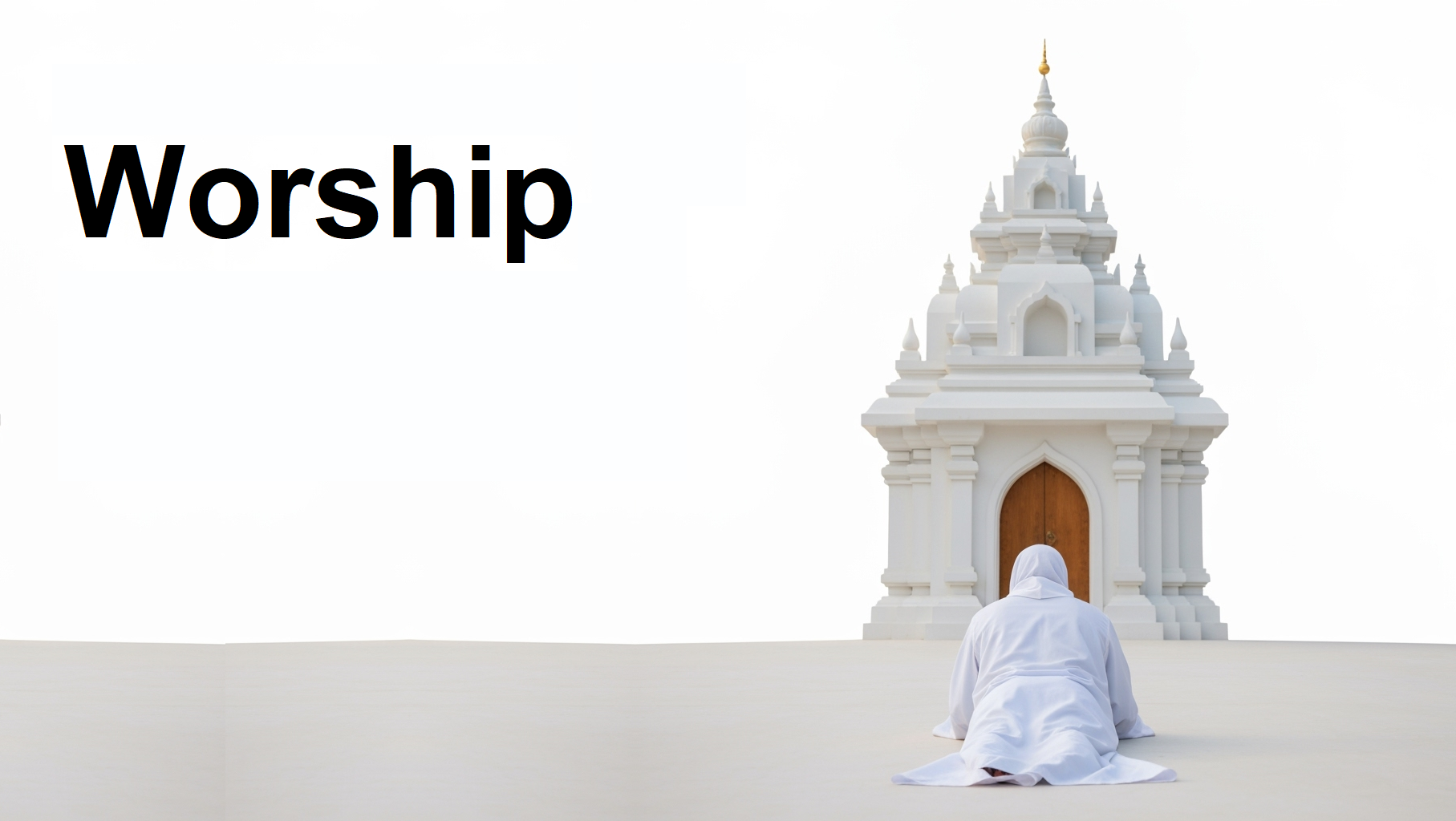
There are words in Christianity that many Christians use without really understanding what they are saying. One of those words is "worship." We say that we are going to worship God. But if someone asks us what worship is or what you do that is worshiping, we often don't have an answer.
In this study, we will learn about worship, what it is, why we do it, and how we do it.
If we look at a dictionary to understand “worship,” we don't get a lot of help. We find that it is associated with words like devotion, respect, adore, venerate, and admire. The help we get, though, is the understanding that it starts in the heart. We know this because true devotion, respect, and admiration come from the heart. Together these words show us that the root of worship is a deeply seated love. This love motivates us to engage in acts of worship.
That's the dictionary, but what does the Bible say about worship? It turns out that worship changed from the Old Testament to the New Testament.
In the Old Testament, personal worship was always about body position, either kneeling or lying facedown. These were positions of humility. When you went to the temple to worship, you would be spending some time in one of those positions.
The worshipful acts you would be doing consisted of physical sacrifices. Sometimes these were animals, but they could also be foods or drinks.
Jesus spoke about this change in worship that will come.
23 But the hour is coming and now is, when the true worshippers will worship the Father in the Spirit and in the Truth, for the father also is seeking such worshippers as these. 24 For the Spirit is God, and it is fitting that those who worship him worship in the Spirit and in the Truth. (John 4:23-24)
From the context of these verses, we can tell what Jesus means by "in the Spirit" and "in the Truth." He has been saying to the Samaritan woman at the well that the time is coming when people will not worship at her mountain or in Jerusalem. Instead each person will be his own temple and will worship there, so location will not matter. He says they will worship in their spirit (and the Holy Spirit).
He also tells her that they will worship in truth. The problem with worshiping in humble positions is that your body can be humbled without your spirit being humbled - a lie. This new worship will be in truth.
Jesus says that God wants worshippers like these. In fact he has always wanted worshippers like these. Even for those who were face down, God wanted them to worship in spirit and truth.
That didn't mean there would be no false worship in Christianity. There is worship that is not in truth, which is not acceptable to God. For example, the worshipful actions can be done for the wrong reason. Instead of worshiping from a loving heart, they can come from:
These were often a problem for Israel, and God rejected their worship, sacrifices, and offerings because they were not worship but merely acts.
Some people might ask why God needs to have humans worshipping him? Does he have some kind of ego thing going on? What value does he get from it?
These questions show a misunderstanding that is important to correct. God gets as much out of our worship of him as we would get out of the ants in our driveway worshiping us. From a benefit perspective, worshipping God is for our benefit, not his. It may seem a little odd that the honor we give to God is for our benefit, but that is the way God created us.
The humility that comes with understanding the greatness of God is good for us, as are the various acts of worship that are an expression of our love for him.
Even if there was no benefit to God or to us, he would still be deserving of our worship because he is God and our creator.
The topic of acts of worship came up earlier, but what are they? In some other religions, the acts of worship included acts of self-mutilation, like cutting oneself, or acts of immorality, such as sex with temple prostitutes. In some cases there were acts of human sacrifice. These are not acceptable to God, so we know that some acts that might be thought of as worship are not.
Part of Jewish worship involved animal sacrifices. We might wonder why God commanded them to sacrifice in this way, but we do not. It is, after all, the same god that we are worshipping. The answer comes from King David
16 You do not delight in sacrifice, or I would bring it; you do not take pleasure in burnt offerings.
17 My sacrifice, O God, is a broken spirit; a broken and contrite heart you, God, will not despise. (Psalm 51:16-17)
David is specifically speaking of sacrifices for sin. God did not want only sacrifices. If God had wanted them, he would have also wanted his people to sin … because these sacrifices were for sin. Plainly he didn't want his people to sin. David says that God really wants humility and repentance / remorse (contrition). Out of this kind of heart come the sacrifices God does want.
Isaiah says the same thing that David said.
2 […] These are the ones I look on with favor: those who are humble and contrite in spirit, and who tremble at my word. (Isaiah 66:2)
When David says "My Sacrifice …" his words tell us something about the worship God does expect from us. God still expects sacrifices from us, but not the physical sacrifices of the Jews. He wants spiritual sacrifices. In fact he wants the same spiritual sacrifices that he wanted from the Jews - the sacrifice of your “self”. He wants a humbled heart, a repentant attitude, and a deep respect for his word.
The Jews understood that you weren't only sacrificing an animal, food, or drink. You put yourself into that thing. Therefore, in that sense, it was you that you were sacrificing.
The apostle Paul takes this a step further.
1 I beg you therefore, my brethren, by the mercies of God, that you present your bodies living sacrifices, holy and acceptable to God by a logical service. (Romans 12:1)
Of course Paul isn't talking about the physical sacrifice of your body, but the sacrifice of all the desires of your body and your self. God wants the complete devotion of all of yourself. This is the worship God desires and always has desired.
This love and devotion naturally result in expressions of worship. One of the minor prophets, Hosea, says this:
2 Take words with you and return to the Lord. Say to him: "Forgive all our sins and receive us graciously, that we may offer the fruit of our lips. (Hosea 14:2)
Translations of this verse, like the one above, change what the author actually said to make it easier for modern readers to understand. But in making that change, they have removed something of value. A more direct translation of that verse would end more like
[…] offer our lips as sacrifices of bulls.
The author is talking about words of repentance and praise for God from our lips and saying they are like the sacrifices of bulls.
From this we see that repentance and praise are part of worship.
The author of Hebrews says something very similar to Hosea
And through him let us offer sacrifices of praise always to God, which is the fruit of the lips giving thanks to his name. 16 And do not forget charity and sharing with the poor, for with these sacrifices a man pleases God. (Hebrews 13:15-16)
The way he looks at it, all worship is through sacrifice.
In this lesson so far, we have heard about these specific sacrifices:
But to these we could add:
From this we see that there are many ways to worship. And we see that everything about assembling with God's people is worship … unless your mind is on the Spurs game at 2:00. From taking the time to attend, spending the money to get there, singing the songs, joining in the testimonies, learning from the Bible, giving to others in the church, it's all worship.
But worship is useless unless it is done in spirit and truth. Fasting is just dieting unless we do it in spirit and as a sacrifice to God. Songs become just repetitious words unless we stop to think about what they mean.
Praise is worthless unless it comes from the heart. Some people shout out "Praise the Lord" or "Hallelujah" so automatically that it seems mechanical. In one case, I remember a person who even sounded mechanical.
With so many things being acts of worship, we might wonder what things would not be worship. Here is a list of characteristics that will help to separate out acts that are not for worship.
God accepts our worship like a parent receives a gift from a child. There is nothing we can do or give that would impress God. God might be impressed at how far we have come relative to other people in similar circumstances, just as a parent might not be impressed by a drawing given by a child but would be impressed at how much better it is than the last one. Just like a parent, God wants to know that the gift was given with the right heart. Was it given in love, or was it an attempt to get the parent to do something? Was it done because the child has gotten into the habit of doing it?